
 By
The morning after a spring hailstorm, yard signs start appearing all over the neighborhood. Trucks with magnetic logos circle the cul-de-sacs, and before lunch someone has knocked on your door to say your roof is “totaled.” It may be. It may also need a dozen shingles and a new pipe boot. Telling those two apart is worth real money.
If you call in a roofing company in Montgomery County to settle it, look for a crew that has been around through several storm seasons. The Magnolia team on Tamina Road is a good example. They’re GAF and CertainTeed certified, accredited with the BBB, and do storm restoration on homes from The Woodlands out to Willis. They’ve also gone back and forth with insurers for owners who were sure an adjuster got it wrong. That experience counts most on the gray-area roofs, where the honest answer could go either way.
What follows is how the decision actually gets made, so you can follow the reasoning instead of just taking someone’s word for it.
Same Storm, Different Verdicts
Picture two houses on the same street, built the same year, hit by the same cell of hail. One gets a repair ticket and the other gets a full tear-off. That can be completely legitimate.
The first house had its roof replaced six years ago. The shingles are still flexible, the granules are mostly intact, and the hail cracked a handful of tabs on the west slope. The second house is on its original roof from 2009. The shingles were already brittle and curling at the edges, so the same hail shattered mats across every slope. The storm was the same, but the two roofs went into it in very different shape. Age and condition before the storm count as much as the size of the hail.
Signs a Targeted Fix Will Hold
A repair makes sense when the damage is contained and the rest of the roof still has years left in it. You’re usually in repair territory when you see things like these.
- Wind lifted or tore off a small group of shingles along one edge or ridge.
- A falling limb punctured one area and left the decking around it solid.
- Flashing around a chimney, skylight or vent pulled loose, but the field shingles look healthy.
- Hail dented metal vents, gutters and the AC fins, yet the shingle mats underneath aren’t fractured.
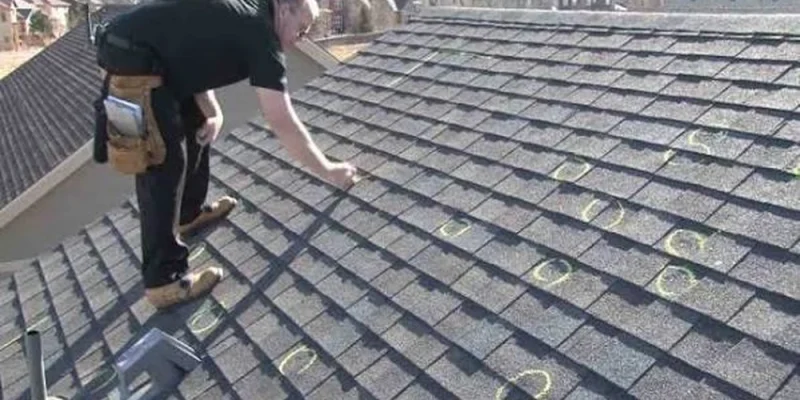
That last one fools a lot of homeowners. Dented gutters look dramatic, but gutters dent much more easily than a sound shingle does. An inspector should check the shingles on each slope, often marking test squares with chalk and counting hits, instead of judging the roof by its gutters.
When Patching Starts Wasting Money
There’s a point where repair money buys you only a year or two. The roof is usually past that point if several of these are true. Damage shows up on most slopes instead of one face. Granule loss has left bare black spots, and the gutters are full of granules after rain. The decking feels soft when someone walks it, which usually means water has been getting in for a while. The shingle is discontinued, so any patch will be a mismatched color that buyers notice right away.
Discontinued shingles cause more trouble than most people expect. Shingle lines change every few years, and a “close enough” color on a front-facing slope can drag down curb appeal at resale. Some policies address matching and some don’t, so the wording in yours matters.
The Insurance Arithmetic Nobody Explains
This is where the decision can surprise you. Before anyone climbs a ladder, pull out your declarations page and look at your wind and hail deductible. In Texas, many policies set that deductible as a percentage of the dwelling coverage instead of a flat dollar amount. On a modest repair, the deductible can come close to the full cost of the job, so filing a claim may not be worth it.
If the damage clearly goes past that number, the order of steps matters.
- Photograph everything from the ground and note the storm date.
- Make temporary fixes such as a tarp over an opening, and save the receipts.
- Hold off on permanent repairs until the adjuster has seen the roof.
- Have your own roofer there for the adjuster’s inspection so the two can compare findings on the spot.
Payment usually comes in stages. With replacement cost coverage, the first check is often the depreciated value, and the rest is released once the work is done and documented. An actual cash value policy only pays the depreciated amount, which can make an older roof replacement a much bigger out-of-pocket hit.
The Texas Department of Insurance lays out the basics of roof claims and replacement under a homeowners policy, including deductibles, the two-check payment pattern and what to ask your agent. One warning is worth repeating. Any contractor who offers to “cover” or waive your deductible is breaking state law, and that offer tells you how the rest of the job is likely to go.
Why Brand Systems Tip the Scale
Major shingle makers sell their roofs as complete systems. That includes the starter strip, underlayment, ridge cap and ventilation, all from the same manufacturer. Their strongest warranties generally require the whole system installed by a certified contractor. A patch job usually can’t qualify for those. A full replacement can, and some of those warranties cover workmanship for decades instead of just materials.
If you plan to stay in the home a long time, that coverage is worth weighing. It’s also a good time to ask about impact-rated shingles. They cost more up front, but some insurers give a premium discount for Class 4 products, which helps on a roof in a hail-prone area.
Pine Shade, Humidity and Attic Heat
Local conditions affect how long either choice will last. Roofs under tall pines collect needles in the valleys, and those needles hold moisture against the shingles. Shaded north slopes grow algae streaks faster in Gulf humidity. Then there’s the attic. A poorly vented attic in August can get much hotter than the outside air, which bakes shingles from underneath and shortens their life no matter how carefully they were nailed.
So a replacement is more than new shingles. It’s the one chance to fix ridge and soffit ventilation, swap old pipe boots, and add a valley design that sheds pine debris better. A repair can’t solve problems that are built into the roof.
Speed Versus Getting It Right
After a big storm, the busiest crews book out for weeks, and that’s when traveling outfits roll in with low bids and out-of-state phone numbers. A tarp buys you time, and spending that time checking out a contractor is well worth it. A local roofer will still be around for a warranty claim two summers from now. Someone working out of a hotel parking lot usually won’t.
The right answer is the one that fits your particular roof. A five-year-old roof with scattered hits deserves a careful repair and no pressure to do more. A fifteen-year-old roof with fractured mats on every slope deserves an honest replacement conversation, even if the storm only finished off what age had already started. You’re looking for an inspector who tells you which one you have and can show you why.






Comments